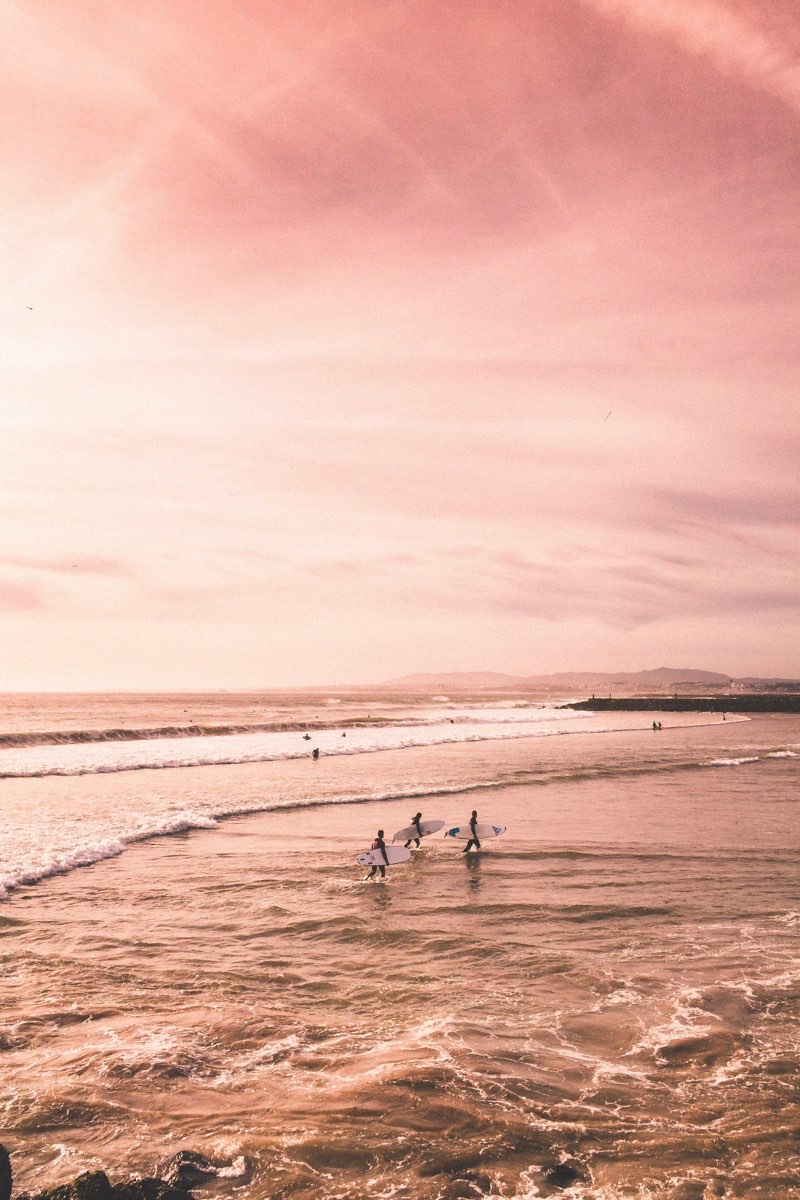
One question keeps coming up: "what's the best beach to learn surfing in Portugal?". The honest answer isn't what you'd expect. It's not the beach that makes the lesson — it's the day. And it's the school.
I've taught lessons at beaches that look perfect on Instagram but were impossible for beginners. And I've watched groups have a blast at "less famous" beaches because the swell was lined up, the wind whispered offshore, and the instructor picked the right corner of the sand. This article explains how to decide well.
The myth of the "beach ranking"
Lists like "the 10 best beaches to learn surfing" mislead. A beach that's fantastic in June at 0.8m with light wind can be unsuitable in October at 2.5m onshore. Surfing isn't static. That's why a good school doesn't promise a beach — it promises to adapt the lesson to the day. If it's raining sideways and the sea is chaotic, they switch spot, switch hour, or swap for paddle work and theory. They never put you in the water when it isn't safe.
The best instructors in Portugal have 4 or 5 beaches in their zone and pick the one for the day first thing in the morning, based on wind and tide. Trust their judgment — it's literally their job.
The 4 marks of a school that knows what it's doing
1. RNAAT licence. The Registo Nacional de Agentes de Animação Turística licence is mandatory to operate legally in Portugal. Without it, the school is irregular — and its insurance may cover nothing if something goes wrong.
2. SurfBooking ratios respected. SurfBooking sets pedagogical ratios (aligned with PT regulations): 6 beginner students per instructor, 8 students intermediate/advanced, 4 children (under 12) per instructor, and 4 students in a private lesson. A school that crams 12 beginners with 1 instructor is saving costs at the expense of your safety. On Surf Booking we enforce these ratios in software — they can't be bypassed.
3. Public liability insurance. Ask. A serious school shows you the policy number and validity without hesitation.
4. Certified instructors (Grau I, II or III, or ISA). Don't confuse with "20 years of surfing". Surfing well is not the same as teaching well. Certification is pedagogy, not just technical level.
How to read the day before showing up
Three variables matter: swell size, wind, and tide. For your first lesson you want:
Small swell — between 0.5 and 1.2 metres. Bigger and you'll spend the lesson taking beatings in the impact zone and swallowing salt water. Smaller and there's no wave at all.
Light or offshore wind. Onshore (wind blowing from sea to land) makes the surface choppy and hard to read. Offshore (land to sea) cleans the wave face, but for beginners that almost doesn't matter — what matters is that the wind is light.
Right tide for the beach. Each beach has its window. The school knows their beach's window. Book your lesson in the window the school chose, not at 11am just because it's convenient. Stay flexible.
Surf Today on Surf Booking shows these three variables in real time for every beach, with a 0–10 score that combines everything. Check it before booking.
The 4 beach types (and which to look for)
Flat-sand beach, gentle beach break — the ideal place to start. Sand everywhere, predictably breaking waves, no rocks. Most learning beaches in Portugal are this type: Matosinhos, Espinho, Baleal Sul, Foz do Lizandro, Carcavelos right corner, Caparica's main stations, Amado.
Mixed-bottom beach (sand + some boulders). Works for beginners if the school knows the right tide. There are beaches in the Algarve and the North like this. Don't go solo — trust the beach the school picks.
Point break or reef break. Avoid as a beginner. Coxos, Lagido, Supertubos, North Point — these are advanced peaks with rocky or reef bottoms. Beautiful to watch, terrible to learn at.
Big-wave beaches (Nazaré, Praia do Norte, Aljezur on a big swell). Not an option — not even with an instructor. Beginners don't go in. Period.
Myths I hear every week
"I have to surf where the pros surf to learn better." No. Pros seek demanding waves that punish beginner mistakes. Learning well means small waves, lots of repetition, building sea-reading.
"The Atlantic is too cold in October." Not in a 4/3mm wetsuit. Water in Portugal sits between 14°C and 20°C year-round. Schools always provide the suit.
"The more expensive the lesson, the better." False. There are €30 lessons with 6 people and a certified instructor, and €60 lessons with 12 people and a trainee. Look at the ratios, not the price.
Zone summary — where you can start well
North (Porto, Espinho, Matosinhos): classic beach break, schools with small ratios, colder water but perfect with a 4/3 suit.
Centre (Peniche, Baleal): Baleal Sul bay is probably the best place in Portugal for a first lesson. Consistent small wave, sand bottom, schools everywhere. Detailed Peniche guide.
Lisbon and Cascais (Carcavelos, Guincho, Costa da Caparica): Carcavelos is Lisbon's classic teaching spot. Caparica (Almada area, south of the Tagus, a separate zone) has dozens of teaching beaches. Guincho is more technical — leave it for once you can stand. Lisbon + Caparica guide.
Ericeira: World Surfing Reserve since 2011. Most peaks are advanced (Coxos, Pedra Branca, Crazy Left), but Foz do Lizandro and Ribeira d'Ilhas on small days work for beginners. Ericeira prices and schools.
Algarve (Sagres, Aljezur, Lagos): the west coast (Amado, Bordeira, Arrifana) has consistent swell. The south coast (Lagos, Sagres-south) is more sheltered, ideal on big-swell days on the west. Detailed Algarve guide.
What to do before booking
Open Surf Today, check the day's score for the zone you want, choose a school with a Partner badge (we've verified licence + insurance), and book. If the day shifts, the school contacts you to propose a different time or beach. That's how it should be.
And don't kid yourself with expectations: on the first lesson you'll probably stand up 2 or 3 times. That's normal. Surfing is a sport that takes time — and that's exactly why it's addictive.
See today's conditions → Surf Today
Also relevant: What to expect from the first lesson · Best time of year · How much a lesson costs
Related
Explore zones
More articles
How much does a surf lesson cost in Portugal in 2026 — honest guideComplete Guide: Your First Surf Lesson — What to Expect