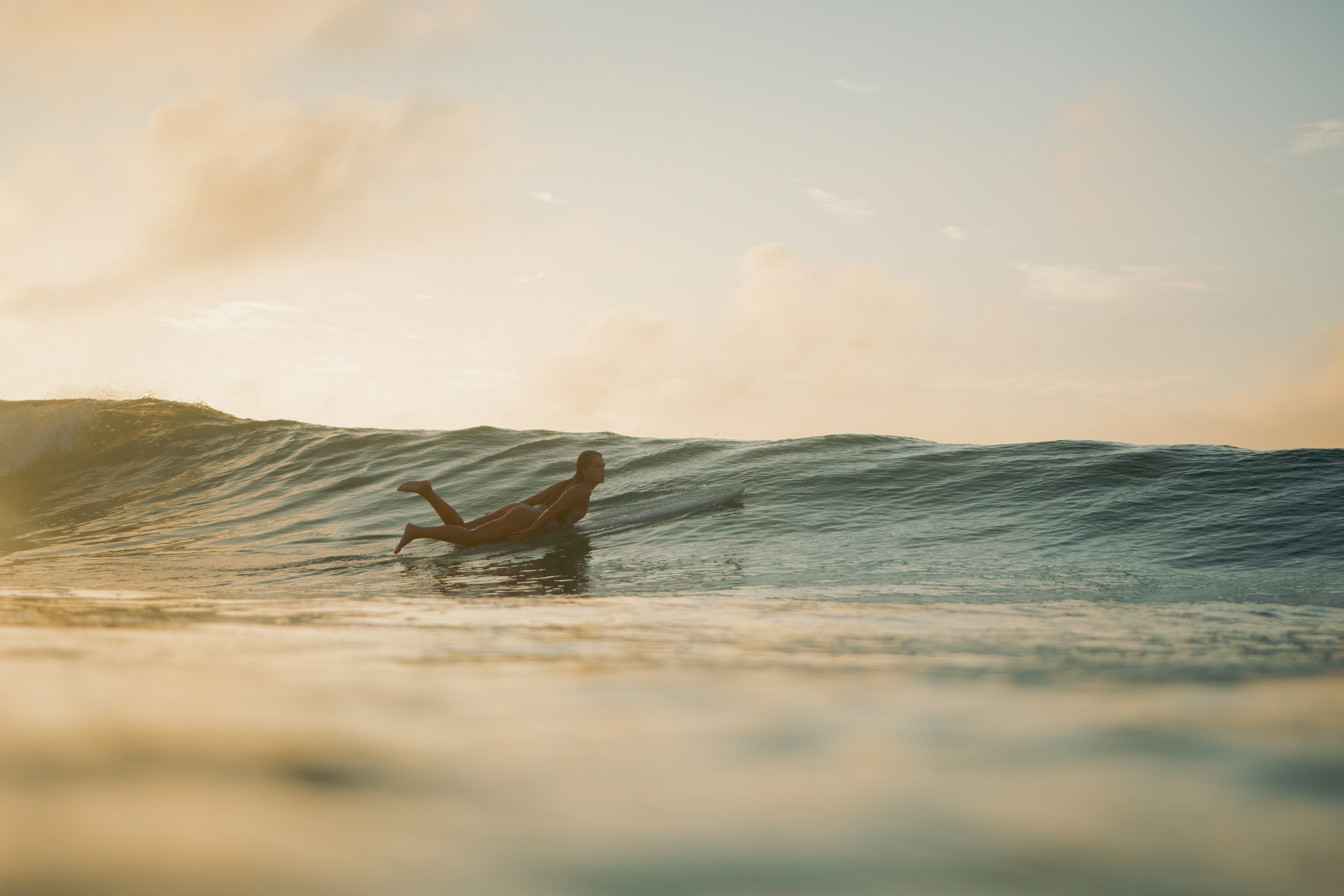
When you watch experienced surfers heading out, it looks like they're barely moving. They look like you, but with half the effort, reaching the peak before you do. The difference isn't strength. It's paddle technique — and it's where almost everyone wastes time in the first weeks.
Body position
Before the arm, the body. Chest slightly raised, chin looking ahead, feet together pinned to the tail of the board. When your chest sits well over the board, the nose lifts 2-3 fingers above the water — no more. If the nose dives, you've slid too far forward. If the tail is fully submerged, scoot back.
Feet together, always. Open legs double the paddling effort.
The arm as a scoop, not a paddle
The most common mistake: stiff arms slapping the water. The hand enters the water with fingers together, slightly cupped, and pulls under the board — not beside it. Imagine you have a big scoop pushing wet sand back behind your feet. Slow, deep, long.
Each stroke should move the body, not the water. If you hear a lot of splash, you're wasting energy.
Cadence, not sprint
The instinct is to paddle fast when you see a wave coming. Almost always the opposite is true: long, rhythmic strokes go further than short, breathless ones. Think breathing — one stroke per breath, with a pause between. When the wave is really there, you accelerate in the last 5 metres, not the first 50.
The smarter route
Don't paddle through the breaking zone where the other surfers are. There's almost always a lane of calmer water, usually to the side, where the current helps you out. Locals use it without thinking — when you see one taking the "shortcut", follow.
What to do with whitewater
If a set catches you on the way out, two options. Turtle roll — flip the board upside down, grab the nose and rails, let the wave pass over. Works with bigger boards (longboard, soft top). Duck dive — push the nose down with arms + a knee, dive under the wave. Only works with small boards and once you have the feel.
In the first month you'll try both and fail. That's the deal. The point is not to stop — whoever stops in the whitewater gets washed back to the beach and has to start over.
Work outside the water
If you want to speed up progression, one exercise beats them all: swim. Front crawl, 20-30 minutes, twice a week. Surfing is 80% paddling and 20% surfing — those who swim well surf more.
Where to learn properly
The first days in the water with an instructor save months of frustration. Certified schools in Portugal fix your posture from the first briefing — you feel the difference in the first session. Find the right beach for your lesson on Surf Today and book in seconds.