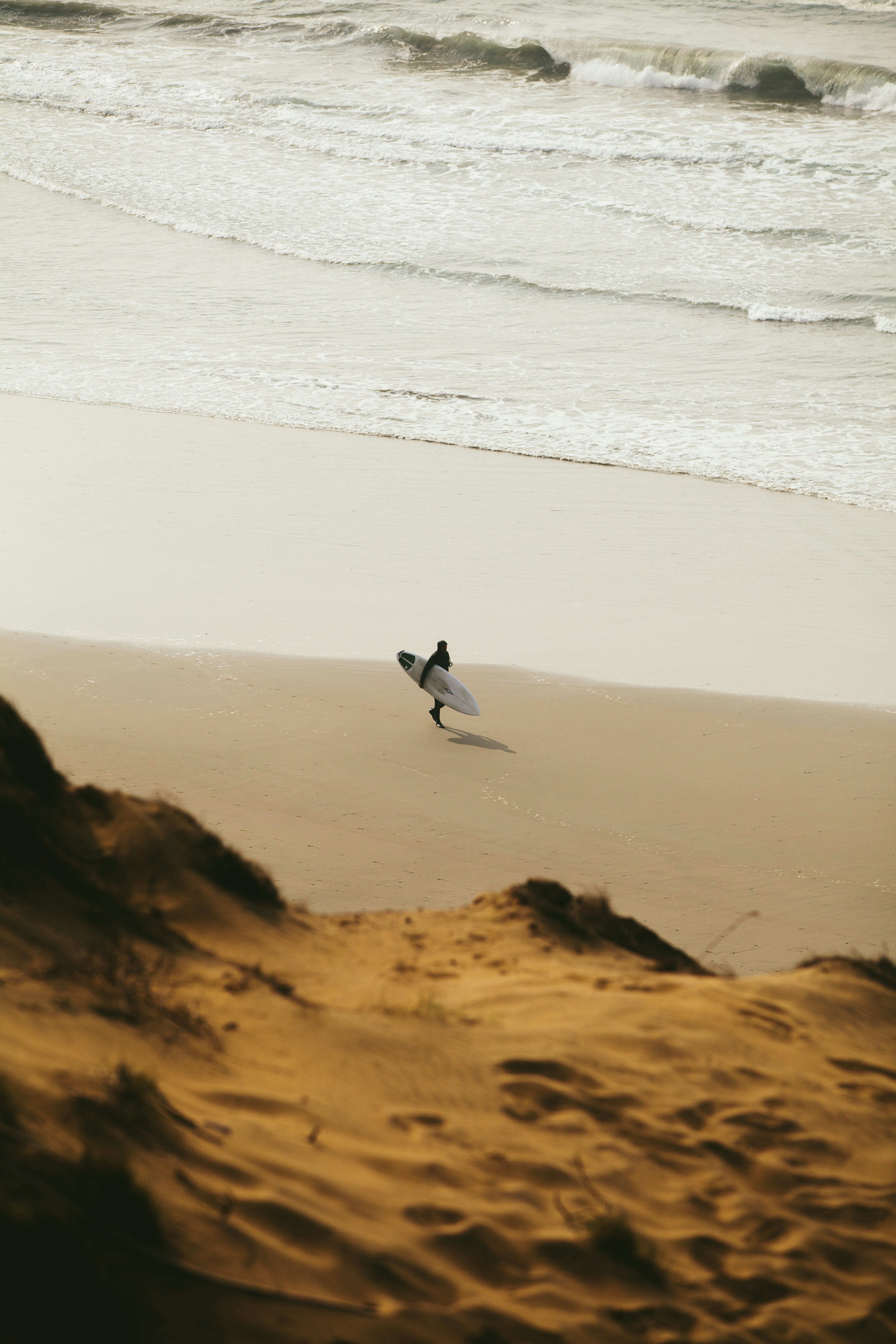
This same beach, six hours later, has half the sand. It is the one variable in surfing that changes every day at set hours — and that you can know months in advance.
Everyone who starts goes through this: one day it was good, you come back the following week at the same hour with the same forecast, and it's useless. Almost always the swell is not to blame. The tide is.
How much the water rises and falls, in Portugal
On the mainland coast the average astronomical tidal range is around 2.1 metres. On spring tides — the days around the new and full moon, when the Sun and the Moon pull in the same direction — it gets close to 3.6 m, and in Lisbon it has been measured above 4 m. On neap tides — first and last quarter, with the Sun and Moon cancelling each other out — it sits between 1.4 and 2.5 m.
Translated for someone standing on the sand: on a flat beach in Caparica or Peniche, three metres of water height means tens of metres of sand appearing and disappearing. The wave breaks somewhere else, over a different bottom, at a different angle. It isn't the same beach.
The clock: six hours and a bit
Portugal has a semi-diurnal tide — two highs and two lows a day. Between one high and the next low there are about 6 hours and 12 minutes. And because the cycle is lunar and not solar, the tide runs about 50 minutes later each day.
That is why your good beach at 10am on Saturday is your good beach at 11am on Sunday. Nothing changed — the Moon just got there later.
High, low, rising, falling — and why only two of them matter
Most beginners think in terms of high and low. People who surf think mostly about the movement:
- Rising (coming in) — the water gains depth. It usually gives waves with more push and more body, and many sand beaches "switch on" halfway through the push.
- Falling (going out) — the water drains. Waves get faster and hollower over more exposed sandbars, and rip currents get stronger (see our article on rip currents).
- Slack water — the 30 to 60 minutes around high or low when the water barely moves. It is the calmest moment and, for a first lesson, often the best one.
There is no good tide. There is that beach's tide
This is the part generic guides usually get wrong. There is no such thing as "the right tide for surfing" — there is the right tide for that bottom:
- Long, flat sandy beaches (Caparica, Baleal, much of the Costa Vicentina): usually better on a mid, rising tide. On a very high tide the wave breaks onto dry sand and shuts down; on a very low one it opens up too much and loses its push.
- Rock and reef bottoms (much of Ericeira): they often need water over them — a fuller tide — so the wave doesn't break onto stone. At low tide they stop being a place to learn and become a place to get hurt.
- Sheltered beaches inside bays (several in the Algarve, or Matosinhos): they tend to be more forgiving, and it is one of the reasons they work so well for beginners.
The practical rule, and it is an honest one: the only reliable source on a beach's tide is whoever works on it. A local instructor knows in ten seconds what a model doesn't know in a hundred lines.
What SurfBooking shows you — and what it doesn't
On the map and on each spot's page we show the tide height hour by hour, with a convention that never changes: green when it is falling and blue when it is rising. We also tell you when the tide is the piece that is missing for the day to be good.
What we do not tell you is each beach's ideal tide by guesswork. Where a school has told us its tide window, we show that one — theirs, with their name on it. Where nobody has told us, we say we don't know. A guess presented as a fact is worse than an admitted gap, especially when what is at stake is you getting into the water.
Three minutes that save you a morning
- Check the time of the day's high and low (it's on the map, and it never changes once published).
- Pick your window: to start out, slack water or the first half of the push.
- Add 50 minutes if you are planning the next day at the same beach.