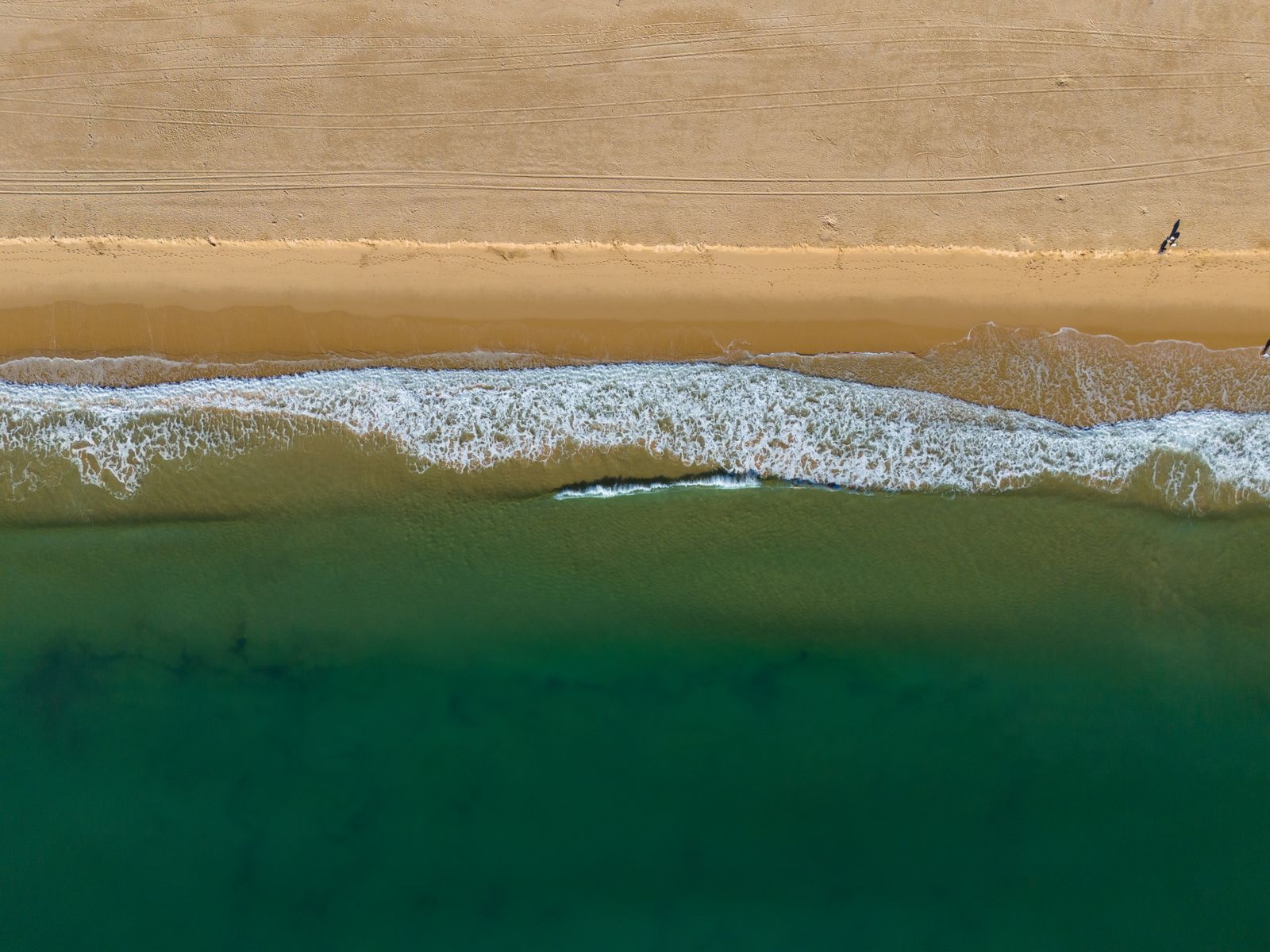
Look at the line of breaking waves in this photo. The wave breaks along almost the whole beach — except in one corridor, where the foam thins out and the water goes darker. That is where the water is heading back out to sea.
It is called a rip current. It isn't a wave, it makes no noise and it doesn't look dangerous — and that is exactly why it is the number one cause of rescues on the Portuguese coast. Plenty of people walk into one on purpose, because it looks like the calmest part of the beach.
What it is, in twenty seconds
Waves push water up the sand. That water has to go back, and it goes back through the deepest path it can find — a channel between sandbars, or alongside a groyne or rocks. It is a river flowing out, narrow and fast. It does not pull you under: it pulls you out.
How to see it from the sand — four signs
- Calmer water in the middle of the breaking waves. If there is foam everywhere and one spot where there isn't, that spot is not the safest one — it is the channel.
- A different colour. Darker, because it is deeper.
- Foam or sand moving away from the beach, instead of coming in with the waves.
- A line of choppy water running straight out, perpendicular to the shore.
It shows up far better from somewhere high. Before you go in, walk up to the boardwalk or the dune and look for two minutes. It is the best investment of time you will make all day.
If it catches you: what rescuers and researchers say
We are going to be straight with you here, because the two most widely taught answers in the world are not quite the same — and it is worth knowing why.
In Portugal, the official guidance (Instituto de Socorros a Náufragos and the Maritime Authority) is: don't swim against the current, swim parallel to the shore until you stop feeling it, and only then head back to the sand. If you can't get out, save your energy, stay afloat and raise one arm so the lifeguard can see you.
Research over recent years has added something: 80 to 90% of the rip currents studied circulate inside the surf zone rather than running straight out to open sea. People who float tend to come back to the breaking zone on their own within a few minutes. That is why organisations such as the UK's RNLI teach float on your back, stay calm first, and only then swimming sideways for those who are confident in the water.
Neither one works 100% of the time, and the study that compared them says so in plain words: swimming parallel fails when you swim against the sideways leg of the circulation; floating fails when the channel really does run offshore. What the two have in common, and what actually saves people, is this:
Don't fight the current. Nobody swims faster than it, and what kills is exhaustion — not the water.
What NEVER to do
- Swim straight for the beach. That is swimming against the river. You lose your breath and you stay where you are.
- Go in after someone in trouble without a buoy, a board or anything that floats. Many drownings in Portugal are of the person who went to help.
- Let go of your board, if you are surfing. That board is the best flotation device you will ever have. Hold on to it and raise an arm.
One thing SurfBooking does NOT tell you
On our map we show sea current when it is above normal. That is the general drift of the area — and it is not the same thing as a rip current.
Rips are local: they come from the sandbar of that beach, on that day, and they change with a tide or a storm. No forecast model sees them, and we do not predict them. We are telling you this because the alternative — letting you believe the app warns you — would be worse than saying nothing at all.
The people who do see them are the lifeguard on that beach and the instructor who works there every day. On a patrolled beach, ask before you go in. It is free and it takes ten seconds.
Where they are most common in Portugal
On long sandy beaches with bars and channels — Costa da Caparica, Peniche/Baleal, Costa Vicentina — and always alongside structures: groynes, jetties, rock heads. The water runs along the structure and exits there. They get stronger on a falling tide and with bigger swell.
The simplest way never to have this problem
A first lesson with a school solves this for you without you having to learn anything: the instructor reads the beach before you go in, picks the spot, and stays in the water with you. It is the difference between learning to swim in a river and learning in a pool.
See today's conditions on the map · find a school on your beach