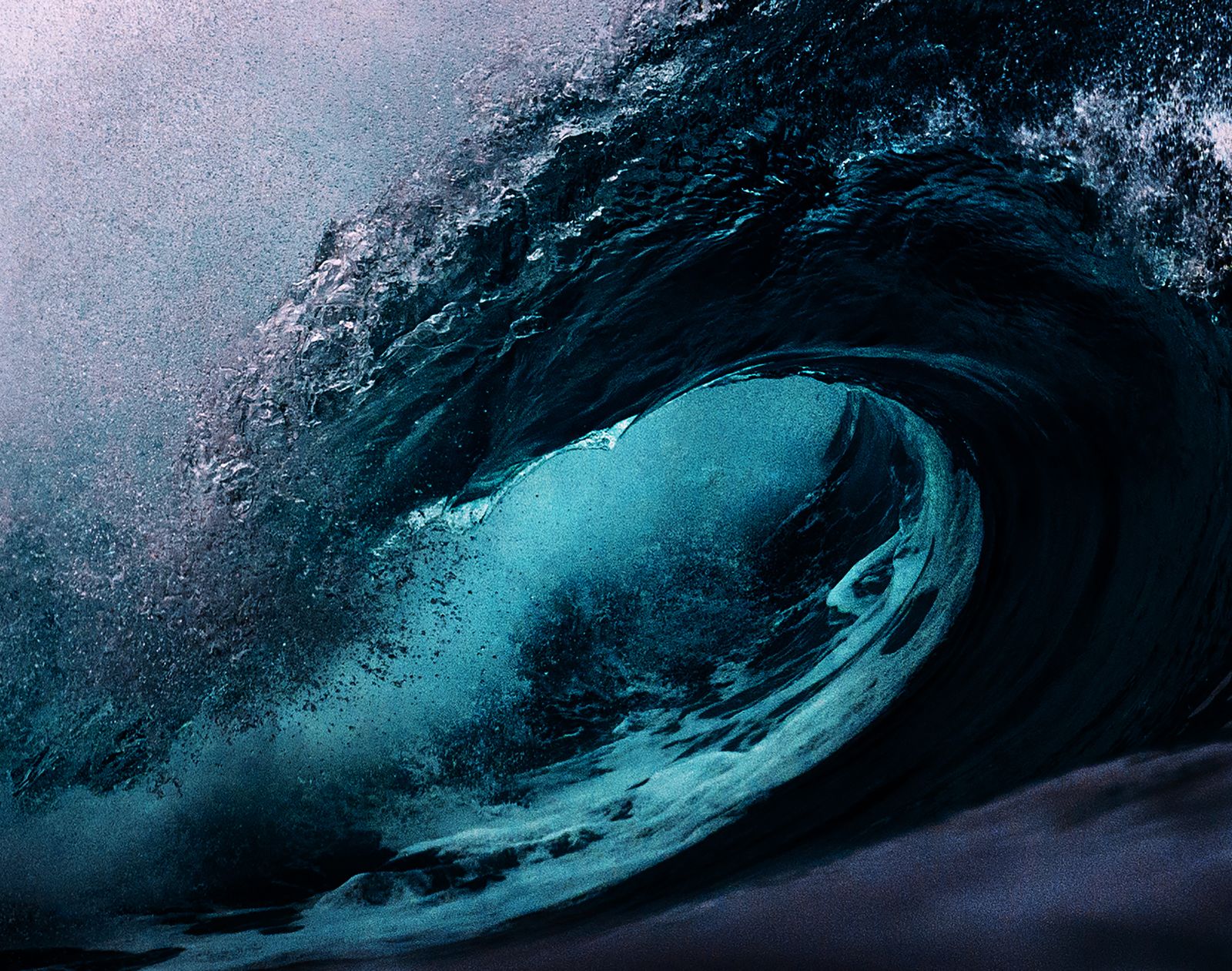
Look at the crest of this wave: the spray is going backwards, against the direction the wave is travelling. That is what an offshore wind does — and it is the visual signature of a good day.
You can have the right swell and the right tide, get to the beach, and find nowhere to surf. Almost always it's the wind. And unlike swell, which comes from storms thousands of kilometres away, wind is local, it changes within hours, and you can see it the moment you look at the sea.
The only thing you need to understand
Wind does two things to a wave. It gives it shape or it wrecks it, and the difference is the direction it blows from:
- Offshore wind — blows from the land out to sea, into the wave. It holds the crest up, delays the break and leaves the face smooth and defined. It is the wind in the photographs.
- Onshore wind — blows from the sea towards land, pushing the wave from behind. It makes the lip fall too early, takes the shoulder away, and fills the surface with chop.
- Cross-shore wind — blows along the beach. It is the most common one in Portugal in the late morning, and it is what makes the sea look "messy" without being properly bad.
There is a simple physical reason why onshore is always worse: chop comes from the distance the wind blows over water before it reaches you. With an offshore wind that distance is metres — it has only just left the beach. With an onshore wind it is kilometres of open sea, and it arrives already churned up.
How much wind is too much wind
The rule of thumb almost everyone uses, and it is ours too:
- Up to ~10 knots offshore (≈18 km/h) — the sweet spot. Clean, shaped, predictable.
- Above ~15 knots offshore — it starts to get in the way: the wave is hard to catch because the wind holds it up too much, and the spray goes in your eyes.
- Above ~12-15 knots onshore — the day is spoiled for learning. It isn't dangerous in itself; it is confusing, tiring and nobody enjoys it.
- No wind at all — better than onshore, every time. A glassy, windless sea is a perfectly good day.
Why people surf in the morning in Portugal
It isn't romance and it isn't the light. It is the thermal cycle of the coast: at night the land cools faster than the sea, and at daybreak the air runs from land to sea — offshore wind, light. From mid-morning the sun heats the land, the air rises, and the sea comes in to fill the gap: the nortada, the north-westerly that in the Portuguese summer shows up almost every day and doesn't stop until late afternoon.
In summer, along almost the whole west coast, the best sea of the day happens before 10am. It isn't surfer superstition — it is the wind changing direction with the sun.
It is also why so many schools schedule beginner lessons early. They aren't being early risers: they are catching the one window of the day when the sea is tidy.
The right beach is the one with its back to the wind
The best tool against wind isn't waiting — it is changing beach. A coastline as indented as Portugal's offers natural shelter, and a beach facing away from the wind can be glassy while the one next door is impossible:
- Strong nortada (the most common case from May to September) — look for shelter south of a cape or a headland. It is the reason there are days when Carcavelos and the Cascais line are calm while Caparica is all chop.
- Southerly wind (more of a winter thing, with fronts) — everything inverts, and the sheltered beaches become the exposed ones.
- In the Algarve the choice is even easier: the south coast and the west coast get different winds on almost any given day, and they are twenty minutes apart by car.
What SurfBooking does with this
Wind is one of the components of the score we give each spot, and it doesn't go in there as a loose number: it goes in relative to that beach's orientation, which is the only way the same direction can be good in one place and bad three kilometres away. That is why, with the same wind, you will see different spots with different scores on the map.
And when wind is what's spoiling the day, we say so in words instead of just showing you a lower number. A bad day explained is worth more than a bad day scored.
Takeaways
- Look at the direction first, the speed second. 15 knots offshore and 15 knots onshore are two different days.
- In summer, plan for early. The nortada shows up almost every day.
- If the wind is bad on your beach, look for the one with its back to it before you write the day off.
See today's wind spot by spot · find a school that already knows where to go